
Share
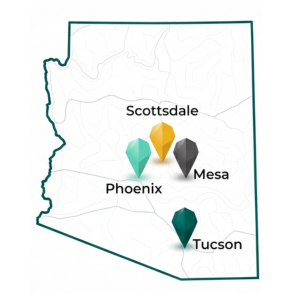
Arizona remains one of the most active fix-and-flip states in the country, with four distinct metros each offering a different risk-reward profile for real estate investors in 2026. According to ATTOM's 2025 year-end Home Flipping Report, national flipping rates and profit margins have tightened, making market selection potentially more consequential than it has been in years. Arizona's metros range from the entry-level affordability of Tucson to the premium buyer demand of Scottsdale, meaning investors who match their strategy to the right market may find more room for margin than those who treat the state as a single opportunity.
Key Takeaways
- Arizona home sales volume rose 9.0% year-over-year in March 2026, suggesting sustained buyer demand across all four metros, per Redfin.
- Tucson's median sale price of approximately $323K may offer the lowest acquisition costs and widest potential ARV spread of the four metros, per Redfin, making it a compelling entry point for capital-efficient investors.
- Phoenix and Mesa may offer the strongest combination of deal flow and exit liquidity for investors targeting the $300K-$550K resale range, with both metros showing rising closed sales volume in March 2026, per Redfin.
- Scottsdale's 9.7% year-over-year price appreciation and ~$965K median sale price may give experienced investors access to the highest absolute ARV ceiling in the state, per Redfin.
Which Arizona Market Is Right for Your Next Fix-and-Flip Investment?
The right Arizona market depends on your capital base, risk tolerance, and renovation experience. Tucson may suit capital-efficient investors targeting the widest potential gross spread; Phoenix and Mesa may offer the strongest combination of deal flow and exit liquidity; and Scottsdale may reward experienced operators who can execute at the luxury level. The sections below break down what each metro actually looks like for a fix-and-flip investor heading into the second half of 2026.
Arizona still draws fix-and-flip investors at scale. Population growth, warm-weather migration, and a steady supply of aging housing stock have kept deal flow alive across the state. But "Arizona" is not one market. Phoenix, Tucson, Mesa, and Scottsdale each operate under their own supply-demand dynamics, buyer profiles, and price ceilings. In a tightening margin environment, picking the right one may matter as much as picking the right property.
This post breaks down what each metro actually looks like for a fix-and-flip investor heading into the second half of 2026: entry costs, days on market, buyer demand signals, and the type of operator each market may be best suited for.
What Does the Arizona Market Look Like for Fix-and-Flip Investors in 2026?
Arizona's statewide housing market may be showing signs of stabilization after the volatility of 2021 and 2022. According to Redfin's March 2026 Arizona market data, the statewide median sale price sat at approximately $453,100 as of March 2026, down 1.0% year-over-year, while total home sales volume rose 9.0% over the same period. The median days on market was 64 days, up 4 days from the prior year.
|
Metric |
March 2026 |
YoY Change |
|
Statewide median sale price |
~$453,100 |
-1.0% |
|
Median days on market |
64 days |
+4 days |
|
Home sales volume |
Up 9.0% |
Positive |
|
Avg. months of supply |
4 months |
Down YoY |
Source: Redfin Arizona market data, March 2026.
Those numbers suggest a market that may be gradually shifting toward more balanced conditions. More transactions are occurring, though properties are taking somewhat longer to close, and prices have seen modest softening year-over-year. For fix-and-flip investors, that combination could potentially create more room to negotiate acquisition prices while still accessing a reasonably active buyer pool on the exit side.
The broader national context might matter too. Per ATTOM's 2025 year-end Home Flipping Report, nationwide flipping activity fell to its lowest level since 2020, with gross ROI dropping to 25.5%, the lowest since 2008. That margin compression is partly driven by rising acquisition costs in competitive markets. Arizona metros with lower entry price points may offer more cushion than Sun Belt peers where acquisition costs have outpaced resale value growth.
Within Arizona, each of the four major metros has diverged meaningfully. Here is how they stack up.
How Does Phoenix Compare as a Fix-and-Flip Market?
Phoenix is the largest and appears to be the most liquid market in the state, which could be both its advantage and its constraint.
|
Metric |
March 2026 |
|
Median sale price |
~$460K |
|
YoY price change |
-5.2% |
|
Median days on market |
51 days |
|
Closed sales (March) |
1,577 (+8.6% YoY) |
Source: Redfin Phoenix market data, March 2026.
Phoenix's potential advantages for real estate investors include:
- High transaction volume. More sales mean more comps, more exit liquidity, and more buyer competition for well-executed renovations.
- Diverse buyer profile. Phoenix attracts entry-level buyers, move-up buyers, and relocation buyers from California and other high-cost states, giving investors multiple exit audiences.
- Price accessibility relative to the metro's size. At a median in the mid-$400Ks, Phoenix remains more affordable than comparably sized Sun Belt metros.
The potential constraints are real too:
- Rising inventory. Inventory in Phoenix has risen 15-20% year-over-year, per AZ Real Estate data compiled through early 2026, shifting negotiating leverage toward buyers.
- Buyer leverage in negotiations. With active inventory still elevated and homes spending a median of 64 days on market statewide, buyers in Phoenix may have more negotiating room than during the 2021 to 2022 cycle, according to Redfin's March 2026 Arizona market data.
- Carrying cost exposure. Flippers may need to price exits carefully and could find that longer days on market increase carrying costs relative to the 2021-2022 cycle.
Best potential fit for: Real estate investors who want depth of deal flow and exit liquidity, and who could execute clean, entry-level renovations in the $300K-$450K resale range.
Kiavi Tip: Use Kiavi's ARV Estimator tool to model acquisition price, renovation budget, and projected resale value in Phoenix submarkets before committing to a deal. A few percentage points of ARV accuracy may separate profitable flips from breakeven ones in a tightening margin environment.
How Does Tucson Compare as a Fix-and-Flip Market?
Tucson is potentially one of Arizona's most affordable major metros and may offer the widest gross spread for investors who can manage longer days on market.
|
Metric |
March 2026 |
|
Median sale price |
~$323K |
|
YoY price change |
-0.5% |
|
Median days on market |
79 days |
|
Closed sales (March) |
453 (down from 495 YoY) |
|
Avg. home value (Zillow) |
~$332,818 (-1.8% YoY) |
Sources: Redfin Tucson market data; Zillow Tucson, March 2026.
What potentially works in Tucson's favor for flippers:
- Lowest acquisition costs of the four metros. A $323K median may reduce the capital required to enter a deal and could widen the gross spread before renovation expenses.
- Less competition from new construction. Renovated properties targeting first-time and entry-level move-up buyers may face less new-build competition than at higher price points.
- Fallback rental exit. Tucson's institutional anchors, including a major university, a federal air base, and a large defense employer, may support a rental exit if a flip takes longer to move, providing a demand base that could hold through broader economic cycles.
What may work against Tucson flippers:
- Longest days on market of the four metros. At a 79-day median, carrying costs run materially higher than in Phoenix or Scottsdale.
- Narrowing buyer pool. Closed sales fell from 495 to 453 year-over-year in March 2026, suggesting the need for precise entry pricing and strong presentation from day one.
- Pricing discipline required. Listings priced at market value tend to go pending in 30-40 days. Listings that start too high may sit for 70-100+ days.
Best potential fit for: Real estate investors who prioritize lower acquisition costs and a wider potential ARV spread, and who could execute well-presented renovations targeting the entry-level and move-up buyer segments.
What Submarkets in Tucson May Offer the Most Opportunity?
Tucson's best flip opportunities in 2026 are likely found in established neighborhoods undergoing gradual gentrification, where comps support post-renovation values well above the acquisition price of distressed stock. Investors familiar with the University of Arizona corridor, midtown Tucson, and Catalina Foothills-adjacent submarkets may find the most actionable deal pipelines, though any submarket analysis should be verified with local MLS data before making acquisition decisions.
How Does Mesa Compare as a Fix-and-Flip Market?
Mesa may be the most overlooked opportunity in the Phoenix metro for fix-and-flip investors in 2026.
|
Metric |
March 2026 |
|
Median sale price (MLS) |
~$492K |
|
YoY price change |
-0.5% |
|
Median days on market |
64 days |
|
Avg. home value (Zillow) |
~$436K (-3.2% YoY) |
|
Months of supply (spring 2025) |
~3.5 months |
Sources: Local MLS data March 2026; Zillow Mesa, updated March 31, 2026.
Mesa's case for real estate investors rests on several structural factors:
- Infrastructure and employment anchors. Major data center investments, along with Phoenix-Mesa Gateway Airport's growing commercial operations, are projected to bolster local employment and housing demand through 2026 and beyond, per Home Buying Institute's Mesa market report.
- Affordable entry relative to Phoenix proper. With prices running roughly 10-15% below central Phoenix on comparable properties, Mesa may offer real estate investors more room in their acquisition basis.
- Stable sales volume. Closed transactions in Mesa rose 2.6% year-over-year in March 2026, per local MLS data, modest growth but consistent with a market absorbing inventory without a demand collapse.
- Broadly balanced supply. At approximately 3.5 months of supply, Mesa has not tipped heavily toward buyers, which may support cleaner exits for well-renovated properties.
Where Mesa may require caution:
- Longer days on market. According to Redfin, Mesa scores 53 out of 100 on competitiveness, which may require investors to price exits carefully to avoid extended carrying costs.
- New construction competition. Builders remain active in east Mesa's master-planned corridors, which may put renovated resale products in direct competition with new inventory at similar price points.
- Price ceiling relative to effort. Zillow placed the average Mesa home value at approximately $436,600 as of March 2026, down 3.2% year-over-year, which may limit absolute profit per deal compared to Scottsdale or north Phoenix submarkets.
Best potential fit for: Real estate investors who are looking for Phoenix-metro liquidity at a slightly lower price point, targeting suburban family buyers in the $450K-$550K resale range.
Which Mesa Submarkets May Have the Most Fix-and-Flip Potential?
Downtown Mesa's historic neighborhoods and the Eastmark master-planned corridor on Mesa's east side may represent two different opportunity types. Downtown Mesa could offer lower acquisition costs with appreciation upside tied to ongoing revitalization, while Eastmark submarkets may support higher post-renovation values driven by new-construction-adjacent demand. Both warrant local MLS verification before acquisition.
How Does Scottsdale Compare as a Fix-and-Flip Market?
Scottsdale appears to be Arizona's highest-price metro and the most demanding fix-and-flip environment of the four.
|
Metric |
March 2026 |
|
Median sale price |
~$965K |
|
YoY price change |
+9.7% |
|
Median days on market |
58 days |
|
Closed sales (March) |
620 (up from 597 YoY) |
Source: Redfin Scottsdale market data, March 2026.
That 9.7% price appreciation is notable in a statewide environment where most metros are flat-to-declining. It reflects Scottsdale's position as a luxury and lifestyle market that draws wealthier relocation buyers, second-home purchasers, and affluent retirees.
What potentially works in Scottsdale's favor for real estate investors:
- Price appreciation holding. Scottsdale's median sale price reached $965K in March 2026, up 9.7% year-over-year, according to Redfin, suggesting luxury buyer demand may be holding even as other Arizona metros soften.
- Highest ARV ceiling of the four metros. A median sale price near $965K may offer more gross profit potential per deal than Phoenix, Mesa, or Tucson, for investors who can execute at that standard.
- Exit liquidity at the luxury tier. 620 homes sold in Scottsdale in March 2026, up from 597 the prior year, per Redfin, suggesting transaction volume at the luxury tier may be holding.
What may work against Scottsdale flippers:
- Premium renovation standards required. Buyers at this price point may expect high-end finishes, architectural detailing, and outdoor living features. Under-specced renovations could stall or sell at discounts that compress margins quickly.
- Higher capital requirements. Acquisitions in Scottsdale may require significantly more capital at risk than equivalent deals in the other three metros, which could limit the pool of investors positioned to operate here comfortably.
- Execution risk is higher. Investors less experienced with luxury renovations may find contractor requirements and buyer expectations harder to manage than at lower price points.
May be a best fit for: Experienced fix-and-flip investors with access to luxury-caliber contractor networks and sufficient capital to absorb the higher acquisition and renovation costs that a $900K+ exit demands.
How Do the Four Arizona Markets Compare Side-by-Side?
No single market is objectively the best. A real estate investor with $200K-$250K to deploy at lower leverage who wants volume and exit liquidity may find Phoenix or Mesa a stronger operational fit.
Whereas an investor with access to cheaper capital and patience for longer hold periods may find Tucson's lower acquisition costs produce better gross spreads. Scottsdale may reward experienced operators who can execute at the luxury level.
Here’s a closer look at all four markets to compare:
|
Metro |
Median Sale Price (March 2026) |
Median Days on Market |
YoY Price Change |
Best Fit |
|
Phoenix |
~$460K |
51 days |
-5.2% |
High volume, entry-to-mid range |
|
Tucson |
~$323K |
79 days |
-0.5% |
Lowest acquisition cost, wide spread |
|
Mesa |
~$492K |
64 days |
-0.5% |
Suburban mid-range, improving employment |
|
Scottsdale |
~$965K |
58 days |
+9.7% |
Luxury tier, premium execution required |
Sources: Redfin Phoenix, Redfin Tucson, Mesa MLS data March 2026, Redfin Scottsdale. Median sale price data as of March 2026.
What Should Fix-and-Flip Investors Consider When Choosing an Arizona Metro?
Several variables may shape which metro fits a given investor's strategy. The table below maps each consideration to which market it may favor.
|
Variable |
What to Watch |
May Favor |
|
Renovation budget and finish level |
Tucson/Mesa buyers at sub-$500K tolerate mid-grade finishes. Scottsdale buyers at $900K+ expect high-end materials and architectural detailing. |
Tucson, Mesa: mid-grade. Scottsdale: premium only. |
|
Holding cost sensitivity |
Every additional month on market adds carrying costs. Tucson's 79-day median runs materially longer than Phoenix (51 days) or Scottsdale (58 days). |
Phoenix or Scottsdale for rate-sensitive investors using bridge loan financing. |
|
Capital availability and deal size |
A Tucson flip may require significantly less capital than a comparable-margin Scottsdale deal. Model gross profit AND required capital deployment, not just ROI. |
Tucson for lower capital entry. Scottsdale for investors with deep capital access. |
|
Local team and market knowledge |
All four markets could reward investors with strong local contractor networks and submarket comp fluency. Phoenix and Mesa may be more forgiving for first-time Arizona entrants due to higher transaction volume. |
Phoenix, Mesa for out-of-state investors new to Arizona. |
Kiavi Tip: Kiavi's bridge loan options could help cover qualifying acquisitions across all four of these Arizona metros. Real estate investors comparing deal economics across markets can price out financing directly online in just a few minutes, to understand how capital costs may affect net returns in each scenario.
Final Thoughts
Arizona's fix-and-flip opportunity in 2026 is less about whether the state makes sense and more about which part of it fits your strategy. The four metros covered here represent meaningfully different risk profiles, capital requirements, and buyer dynamics—and that divergence is arguably what makes Arizona worth a closer look for real estate investors who are willing to be selective.
It's also worth noting that Arizona's investment opportunities could extend well beyond these four metros we analyzed. Markets like Chandler, Gilbert, Tempe, and Peoria each have their own supply-demand dynamics and buyer profiles worth evaluating depending on your strategy.
If you're considering your next Arizona deal, take a few minutes to price out a bridge loan online at Kiavi to see how financing costs could affect your projected return across different markets and price points.
Additional Resources
.png)
Explore Related Content

The 7 Best Fix-and-Flip Markets for 2026
Editor's Note - Updated May 2026: This post has been updated to reference the JBREC + Kiavi Q1..

Is Massachusetts the Northeast's Next Fix-and-Flip Opportunity?
Editor's Note - Updated May 2026: This post has been updated to include a reference to Arizona..

Mid-Year Fix-and-Flip Market Check: Where Investors Are Winning in 2026
Not every fix-and-flip market is moving the same direction in 2026. Some states entered the..
You are leaving kiavi.com. Do you want to continue?