
Share
Editor's Note - Updated May 2026: This post has been updated to include a reference to Arizona Fix-and-Flip Markets: 4 Top Cities Compared (2026), which covers how Arizona metro dynamics, including days on market and buyer depth, may affect an investor's decision to flip or hold and refinance into a rental. Read it here →
The BRRRR strategy (Buy, Rehab, Rent, Refinance, Repeat) could give real estate investors a way to recycle their capital and scale a rental investment business without needing fresh funds for every deal. A DSCR loan is often the financing vehicle that makes the refinance step work. According to ATTOM's Q3 2025 U.S. Home Flipping Report, fix-and-flip ROI decreased to 23.1% in Q3 2025, the lowest level since 2008, prompting many real estate investors to shift toward buy-and-hold strategies like BRRRR. Unlike conventional mortgage refinancing, a DSCR cash-out refinance often qualifies based on the rental property's income relative to its debt, not the borrower's personal earnings, which could make it a practical fit for investors with complex income situations or multiple properties in their investment business.
Key Takeaways
- A DSCR loan qualifies based on property cash flow, not personal income, which may benefit investors with commission or self-employment income.
- DSCR is calculated by dividing gross monthly rent by PITIA (principal, interest, taxes, insurance, and HOA), per Kiavi's DSCR loan guide.
- Fix-and-flip ROI decreased to approximately 23.1% in Q3 2025, per ATTOM, drawing more real estate investors toward the BRRRR strategy.
- Seasoning requirements could affect how quickly an investor could complete the refinance step and move to the next deal.
- Buying at or below 70% of ARV may help ensure the post-rehab appraisal supports a meaningful cash-out refinance.
The BRRRR Refinance Step Explained: Using a DSCR Loan to Recycle Your Capital
The BRRRR strategy could offer real estate investors (REIs) a way to keep growing a rental investment business without having to set aside fresh capital for every acquisition. But the strategy may only work if the refinance step delivers. That step is where a DSCR loan typically comes in.
What Is the BRRRR Method?
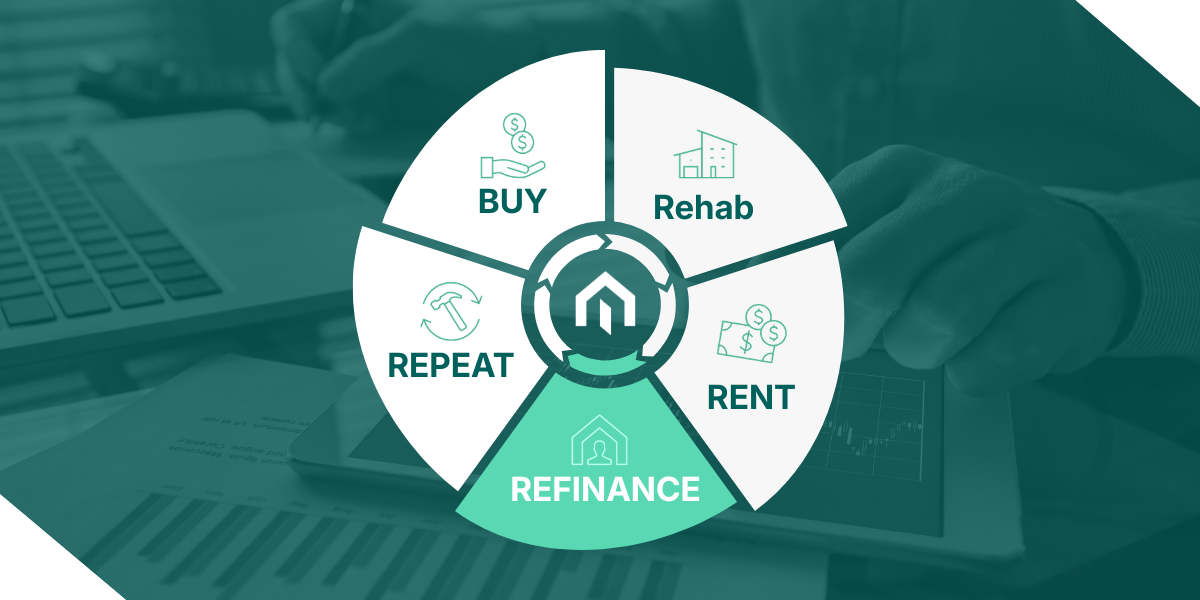
BRRRR stands for Buy, Rehab, Rent, Refinance, Repeat. It is a rental property investing strategy where a real estate investor purchases a distressed property, renovates it to improve its value and rental appeal, places a tenant, refinances into a long-term loan to pull out equity, and uses that equity to fund the next deal.
Here is a simplified look at how the five steps connect:
|
Step |
What Happens |
|
Buy |
Purchase a distressed property, typically using a bridge loan for speed and flexibility |
|
Rehab |
Renovate to increase the property's value and rental income potential |
|
Rent |
Place a qualified tenant and stabilize the property's income |
|
Refinance |
Complete a cash-out refinance into a long-term DSCR loan, pulling equity back out |
|
Repeat |
Use the equity from the refinance to fund the next acquisition |
The difference between BRRRR and traditional buy-and-hold is the recycling of capital. In a standard rental purchase, equity tends to stay in the property. BRRRR investors may aim to recover most or all of their initial investment through the refinance, leaving the property generating cash flow while the same capital goes to work again.
Why Does the DSCR Loan Often Fit the Refinance Step?
After the rehab is complete and a tenant is in place, an investor needs a long-term loan to replace the short-term bridge financing used for the purchase and renovation. This is where a DSCR (Debt Service Coverage Ratio) loan could be a strong fit.
A DSCR loan qualifies based on the property's income, not the borrower's personal earnings. Lenders typically look at whether the property generates enough rental income to cover its debt obligations. This could matter for BRRRR investors in several ways:
- Investors with commission income, 1099 earnings, or self-employment income may find the income verification process simpler, because personal W-2s and tax returns typically are not required
- Investors with multiple properties may not face the same DTI (debt-to-income) constraints that could arise with conventional financing
- The loan could be structured as a 30-year fixed term, which may help stabilize long-term cash flow after the refinance
DSCR rental loans are designed specifically for non-owner-occupied rental properties and could offer a path to long-term hold financing that aligns with how real estate investment businesses operate.
Kiavi Tip: Kiavi's DSCR rental loan is built for investors looking to stabilize a property after rehab and hold it for the long term. You can price out your numbers directly online with Kiavi, in just a matter of minutes.
How Is DSCR Calculated?
DSCR stands for Debt Service Coverage Ratio. It measures whether a rental property earns enough to cover its loan payments. The formula is:
DSCR = Gross Monthly Rent / PITIA
PITIA stands for Principal, Interest, Taxes, Insurance, and HOA (if applicable). It represents the full monthly cost of carrying the loan.
Here is an example:
|
Factor |
Amount |
|
Gross Monthly Rent |
$2,000 |
|
Monthly PITIA |
$1,600 |
|
DSCR |
1.25 |
A DSCR of 1.0 means the property's income exactly covers its debt. A ratio above 1.0 means the property generates more income than it owes in payments. Many DSCR lenders consider 1.25 or higher a healthy ratio, as it signals a cushion above break-even. Some lenders, like Kiavi, may finance properties at lower DSCR ratios depending on the deal profile, be sure to check out their current DSCR terms at, https://www.kiavi.com/loans/rental.
One thing to know: lenders typically use appraiser-estimated market rent in the DSCR calculation, not necessarily the rent on any existing lease. This could work in a real estate investor's favor if a tenant is paying below market rent.
What Do Lenders Typically Look at in a DSCR Refinance?
Beyond the DSCR ratio itself, lenders evaluating a cash-out refinance for a BRRRR property may consider several additional factors. Understanding these ahead of time could help investors set up the deal to qualify.
- Credit score. Many DSCR lenders set a minimum FICO score threshold. A stronger credit score may also help a real estate investor access more competitive terms.
- Property type. DSCR loans typically cover single-family rentals, 2-4 unit properties, condos, and planned unit developments (PUDs). Properties outside that range may require a different financing approach.
- Appraised value (ARV). The lender will usually order an appraisal on the rehabbed property. The cash-out amount is typically based on a percentage of the appraised value—typically in the 70-75% range. If the appraisal comes in below your projected ARV, the amount you can pull out of the deal may be limited.
- Seasoning. Seasoning refers to how long a real estate investor has owned the property before refinancing. Many lenders require a minimum seasoning period before allowing a cash-out refinance. Kiavi's seasoning requirement may be shorter than some traditional lenders, which could allow investors to complete the refinance step more quickly and move on to the next deal.
- Tenant and lease status. A signed lease and occupied rental could help support the DSCR calculation and may be required or preferred by some lenders before closing the refinance.
Kiavi Tip: Before you start the rehab, it may help to run a preliminary DSCR calculation based on your projected ARV and estimated market rent. Use Kiavi's ARV Estimator to sharpen your post-rehab value estimate and check whether the refinance math could work.
How Should Investors Set Up a BRRRR Deal for a Successful Refinance?
The refinance step tends to reflect decisions made at the beginning of the deal, not at the end. Investors who plan backward from the refinance may have better odds of pulling out capital rather than leaving it stranded in the property.
Here are the variables to work through before closing on the purchase:
- Start with your target ARV. Estimate the property's post-rehab value using comparable sales in the area. This is the number the lender's appraiser may attempt to substantiate.
- Apply the 70% rule. A common guideline is to purchase at no more than 70% of ARV minus rehab costs. This tends to leave enough equity margin for the cash-out refinance to return most or all of your initial investment.
Example:
- ARV: $250,000
- 70% of ARV: $175,000
- Estimated rehab costs: $40,000
- Maximum purchase price: $135,000
- Estimate DSCR before you buy. Consider using comparable rents in the area to estimate what the property could generate as a rental. Then model the PITIA based on your expected refinance loan amount and current rates. If the resulting DSCR ratio looks thin, the deal may need renegotiation or a different market.
- Account for seasoning in your timeline. If your lender requires a 6-month seasoning period, plan for that hold time in your bridge loan budget. A lender with a shorter seasoning window could allow you to move faster.
- Document the renovation. Lenders typically want documentation of the property's condition before and after rehab. Good records may support the appraisal and help substantiate the ARV.
What Could Go Wrong at the Refinance Step?
Newer BRRRR investors sometimes find that the refinance step does not go as planned. A few common scenarios to understand:
- The appraisal comes in short. If the post-rehab appraisal is lower than the projected ARV, the real estate investor may pull out less capital than expected—or in some cases, none at all. This is why buying at a deep enough discount from day one tends to matter. In markets where appreciation is slow or declining, forced appreciation through renovations may need to carry more of the weight.
- The DSCR is below the lender's threshold. If rents in the area cannot support a DSCR ratio that meets the lender's requirements, the property may not qualify for the loan terms originally modeled. Checking market rents carefully before purchase could help surface this risk early.
- Seasoning delays the cycle. If a lender requires six months of seasoning and the investor is carrying a bridge loan during that period, holding costs accumulate. Choosing a lender with a shorter seasoning requirement may help reduce this drag.
- The property is not rented at time of refinance. A vacant property may face stricter DSCR underwriting, since there is no income to measure. Placing a qualified tenant before beginning the refinance process could help the deal move more smoothly.
Understanding what the BRRRR strategy requires at each phase—and modeling the refinance numbers before acquiring the property—may give real estate investors the best chance of executing the cycle successfully.
Kiavi Tip: For investors weighing a rental exit if a flip takes longer to move, this look at four Arizona fix-and-flip metros covers which markets may support a BRRRR pivot, including Tucson, where a stable employment base could make a rental exit more viable than in higher-priced metros.
Final Thoughts
The BRRRR method could give real estate investors a framework for building a rental investment business without requiring fresh capital for every deal, but the refinance step is what makes the cycle work. A DSCR loan may be a well-suited vehicle for that step, given its focus on property income rather than personal earnings and its long-term hold structure.
Planning the deal backward from the refinance—estimating ARV, modeling DSCR, understanding seasoning, and buying at the right price—may be what separates investors who recycle capital efficiently from those who find it stuck in the property. If you're evaluating your next BRRRR opportunity, price out a DSCR rental loan online at Kiavi to see how the numbers could work for your deal.
Additional Resources
%20(1).png)
Explore Related Content

Build-to-Rent Financing: Key Insights from the IMN BTR Conference
Build-to-rent financing typically involves construction loans, bridge debt, and alternative..

DSCR Loan Guide: How to Finance Your First Rental Property
Editor's Note - Updated May 2026: This post has been updated to include a reference to What Are..

Is the Rate Lock Effect Fading? What That Means for Investors in 2026
The mortgage rate lock-in effect has kept millions of homeowners in place since 2022, but its..
You are leaving kiavi.com. Do you want to continue?