
Share
Editor's Note - Updated June 2026: This post has been updated to include a reference to Kiavi's June 2026 Investor Pulse. The June issue covers the Federal Reserve's hawkish June rate decision, May foreclosure data, the Figure acquisition, and rental market performance by region. Read it here →
The May 2026 Kiavi Investor Pulse finds the fix-and-flip market may be improving year-over-year but diverging sharply by region, with the Burns + Kiavi Fix and Flip Market Index rising to 63 in Q1 2026, up 5 points annually. Foreclosure starts rose 20% and bank repossessions climbed 45% from the previous year in Q1 2026, potentially expanding distressed deal flow heading into summer. A record 47% of flippers plan to hold more homes as rentals in 2026, though rental fundamentals in Texas and Florida may remain weaker than in Midwest and coastal markets.
Key Takeaways
- Kiavi is rolling out self-serve Automated Draws for bridge borrowers, giving direct borrowers more control over the draw process and inspection access.
- The Burns + Kiavi FFMI rose to 63 in Q1 2026, up 5 points year-over-year, with all three subindices above 60.
- 47% of flippers may keep more homes as rentals in 2026, the highest share in four survey years, per JBREC.
- Foreclosure starts rose 20% year-over-year in Q1 2026, with bank repossessions up 45%, per ATTOM.
- National pending home sales may have reached their highest level since 2023 in April, suggesting the buyer pool could be improving, per Redfin.
Kiavi Investor Pulse: May 2026 Real Estate Market Trends and Financing Updates
Welcome to the May 2026 Investor Pulse. Every month, we round up the market data, financing signals, and product updates that may matter most to your next deal. Here is what moved the needle in April.
This month at a glance:
- Fix-and-flip sentiment rose for the second straight quarter
- Foreclosure inventory increased, potentially expanding distressed deal flow
- Buyer demand improved nationally, though regional gaps remain wide
- A record share of flippers are pivoting to rental holds, but the numbers may not support it everywhere
- Kiavi launched self-serve Automated Draws for bridge borrowers
Fix-and-Flip Sentiment Rose for the Second Straight Quarter
The FFMI hit 63 in Q1 2026, up 5 points year-over-year.
The Burns + Kiavi Fix and Flip Market Index rose to 63 out of 100 in Q1 2026, up from 62 in Q4 2025 and 5 points above the same quarter last year. All three subindices came in above 60: current sales activity at 62, expected sales over the next six months at 66, and deal availability at 64. Values above 50 indicate expansion relative to seasonal norms.
|
Subindex |
Q1 2026 Score |
|
Current Flipped Home Sales Activity |
62 out of 100 |
|
Expected Sales (Next 6 Months) |
66 out of 100 |
|
Availability of Pre-Flip Homes to Purchase |
64 out of 100 |
Source: John Burns Research and Consulting, Q1 2026 Burns + Kiavi Fix and Flip Survey
The forward-looking subindex at 66 may be the most useful number here. It suggests flippers broadly expect conditions to stay constructive through mid-year, even as economic uncertainty holds the top spot on the risk list. 37% of flippers rated current sales as "good," up from 31% one year ago.
The regional story may be less uniform. The Northeast, Northwest, and Northern California appear to be outperforming on both deal demand and exit pricing. Florida and Texas remain some of the weakest markets for flipped home sales, with softer buyer demand and longer days on market weighing on margins in both states.
Kiavi Tip: Regional conditions vary significantly. The Arizona fix-and-flip market comparison and Massachusetts fix-and-flip market analysis break down local conditions across multiple cities if you are active in either state.
Foreclosure Inventory Is Rising. Here Is What That May Mean for Deal Flow.
Foreclosure starts up 20% YOY. Bank repossessions up 45% YOY.
According to ATTOM's Q1 2026 U.S. Foreclosure Market Report, 118,727 U.S. properties carried a foreclosure filing in the first quarter, up 6% from Q4 2025 and up 26% year-over-year. The numbers that matter most for active investors:
|
Metric |
Q1 2026 |
Q4 2025 |
Q1 2025 |
|
Total foreclosure filings |
118,727 |
+6% |
+26% |
|
Foreclosure starts |
82,631 |
+7% |
+20% |
|
Bank repossessions (REOs) |
14,020 |
+2% |
+45% |
|
March filings alone |
45,921 |
+18% MOM |
+28% YOY |
Source: ATTOM's Q1 2026 U.S. Foreclosure Market Report
Foreclosure starts could often be a leading indicator of future distressed inventory. A 20% annual increase suggests REO and pre-foreclosure supply could continue building through Q2 and Q3. Bank repossessions up 45% year-over-year is the most actionable figure for real estate investors running distressed acquisition strategies. ATTOM CEO Rob Barber noted that volumes remain below historical peaks and may reflect gradual normalization rather than a systemic crisis.
State-level REO concentration may mirror the same regional softness in the JBREC data. The largest year-over-year REO increases were in Florida (487 to 1,014), Colorado, Alabama, Washington, and Oregon. Florida's number is especially notable given that Sunbelt flippers are already navigating softer buyer demand and longer days on market.
The Buyer Pool May Be Improving Nationally
Pending home sales hit their highest level since February 2023 in April.
National buyer demand data from Redfin points to potentially improving market conditions heading into spring. The median U.S. home sale price rose 2.4% year-over-year in April 2026, the largest annual gain in 13 months. Pending home sales climbed to their highest level since February 2023, and existing home sales reached a seasonally adjusted annual rate of 4.33 million, also the highest since February 2023.
The rate environment is also modestly more favorable than a year ago. The 30-year fixed-rate mortgage averaged 6.51% as of May 21, 2026, down roughly 35 basis points from the same week one year prior. Rates in the 6-7% range could continue to compress the qualified buyer pool at entry and mid-price tiers, but the annual improvement may incrementally expand demand for flipped homes.
The regional picture for real estate investor exits tends to track closely with general buyer demand:
|
Region |
Price Trend |
Days on Market |
Investor Implication |
|
Northeast / Northern CA |
Positive YOY |
Stable to tightening |
Stronger exit pricing potential |
|
Midwest |
Positive YOY |
Tightening in many markets |
Improving ARV confidence |
|
Florida / Southeast |
Flat to declining in some submarkets |
Lengthening |
Supports rental pivot rationale |
|
Texas / Sunbelt |
Declining in some submarkets |
Rising |
Financing cost sensitivity elevated |
Source: Redfin Housing Market Data, April 2026; JBREC Q1 2026 Fix-and-Flip Survey
A Record Share of Flippers Are Pivoting to Rentals
47% of flippers plan to hold more homes as rentals in 2026, a four-year high.
According to JBREC, 47% of flippers surveyed plan to keep more properties as rentals in 2026 compared to their strategy one year ago, the highest share in the survey's four-year history. Two-thirds of Texas flippers are planning the pivot, the highest of any region. Florida and Southeast flippers are following close behind.
The rationale makes sense on the surface: in markets where buyer demand has softened and exit prices have compressed, holding may look better than selling at a disappointing margin. But the rental data suggests caution, particularly in the same Sunbelt markets driving the trend.
RealPage Market Analytics shows U.S. apartment occupancy at 95.2% in April 2026, improving from a Q1 trough of 94.9%, with rents posting four consecutive months of mild gains. The regional breakdown tells a more complicated story:
|
Region |
Occupancy Trend |
Annual Rent Growth |
Rental Hold Attractiveness |
|
Midwest |
Stable to tightening |
+2-4% YOY |
Strong |
|
Northeast / Coastal |
Stable |
Positive |
Strong |
|
Sun Belt |
Softening |
Negative to flat |
Weaker near-term |
|
Mountain West / Southwest |
Mixed |
Declining in supply-heavy markets |
Selective |
Source: RealPage Market Analytics, April 2026; JBREC Q1 2026 Fix-and-Flip Survey
The South appears to have gone nearly three years without meaningful annual rent growth, per RealPage. For flippers in Texas and Florida planning rental holds, the rental market in those regions may not immediately offset the compressed flip margins that drove the pivot in the first place. Midwest and coastal markets, by contrast, are showing steadier rent gains of 2-4% annually.
One important caveat: RealPage figures cover multifamily apartments. Single-family rental dynamics at the zip code level may vary, and local MLS data could offer a more precise read on SFR demand in a specific submarket.
Kiavi Tip: If you are working through the hold-versus-sell decision, the DSCR loan BRRRR refinance guide and the build-to-rent versus BRRRR comparison break down how the refinance step may work in today's rate environment.
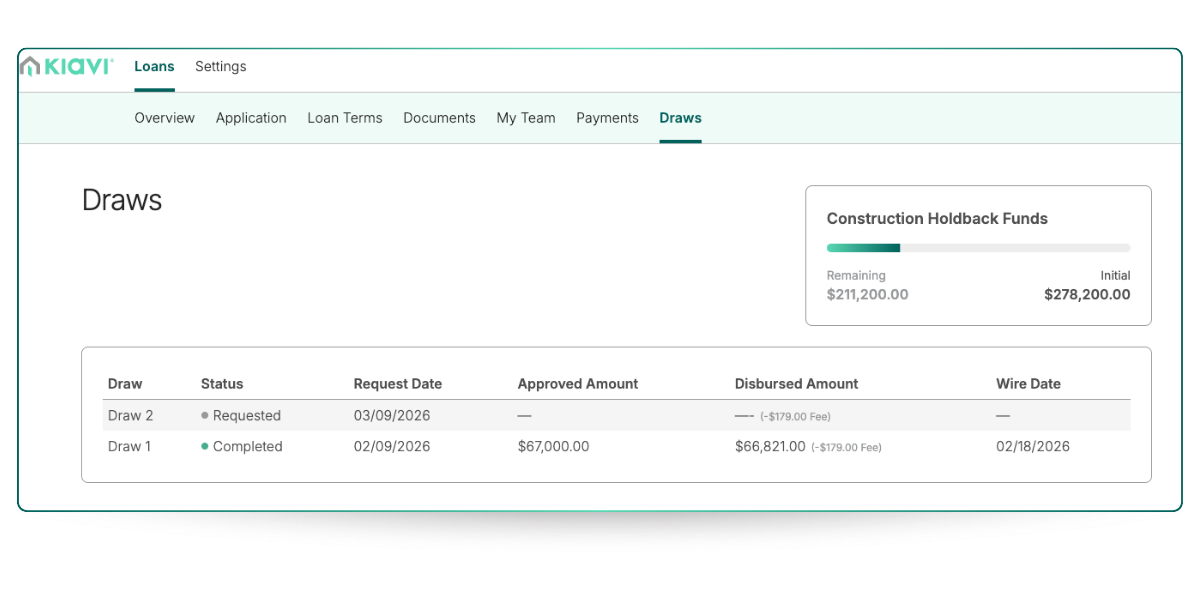
Kiavi Is Rolling Out Self-Serve Automated Draws for Bridge Borrowers
Direct bridge borrowers will soon be able to request draws, track status, and access inspections 24/7 from their dashboard.
Kiavi is currently rolling out upgrades to its borrower dashboard that are designed to give direct bridge borrowers more control over the construction draw process. The updates are being introduced in phases and add a dedicated Draws page with three capabilities:
- Self-serve draw requests: Submit draw requests directly through the portal, without waiting on manual intake.
- Full draw visibility: Track draw status, view complete draw history, and monitor remaining holdback funds in real time.
- 24/7 self-inspection access: Begin the inspection process immediately through Kiavi's third-party inspection partners, with no scheduling required.
For bridge borrowers, faster draw turnaround may reduce carrying costs and help keep renovation timelines on track. Current availability may vary; contact your Kiavi representative for details on access timing. More on bridge loan options at kiavi.com/loans/bridge-loans.
In the News
Kiavi's Q1 2026 Fix-and-Flip Survey data was covered in Scotsman Guide, which highlighted how price declines and demand uncertainty are complicating the outlook for flippers nationally, with particular focus on the geographic divergence between the Sunbelt and supply-constrained markets.
Separately, Kiavi's Tom Hallock, VP and Head of Construction Lending, discussed build-to-rent and housing trends in ApartmentBuildings.com, offering context on how institutional capital is approaching new construction and rental demand as the single-family BTR sector continues to evolve.
For a broader view of what real estate investors were tracking at the start of 2026, the IMN SFR East recap is worth reading alongside this month's JBREC data.
Final Thoughts
The April data points to a market that could be improving at the national level but diverging sharply by region. The FFMI is up, buyer demand is ticking higher, and foreclosure inventory may be opening new deal sourcing lanes heading into summer. At the same time, renovation costs are at a post-pandemic high, economic uncertainty remains the top flipper concern, and the rental pivot story in Texas and Florida may be more complicated than the headline number suggests.
Execution quality, accurate cost estimation, and market selection may matter more right now than broad market sentiment. If you are working through the numbers on your next deal, pricing out a bridge loan at kiavi.com/loans/bridge-loans is a useful starting point.
For updated data on how conditions shifted in May and what the Federal Reserve's June rate decision may mean for your deals, see the June 2026 Kiavi Investor Pulse, which covers foreclosure trends, apartment market performance, and Kiavi's major company news.
Disclosures
This post reflects market data and Kiavi product details available as of May 29, 2026, and is subject to change. Product features and availability may vary.
Loans are for real estate investment purposes only and are not for personal, family, or household use. All loans are subject to Kiavi's standard underwriting, credit approval, and property valuation. Not all applicants will qualify. Final loan terms are contingent on several qualification factors, including credit history, income, investment experience, and the selected loan term.
This information is provided for educational and informational purposes only and does not constitute legal, tax, or investment advice. While Kiavi strives for accuracy, market data is subject to change without notice. Past performance does not guarantee future results. Loans are made or arranged pursuant to a California Financing Law license. For full state licensing and additional state-specific disclosures, please visit kiavi.com/legal/disclosures.
%20(3).png)
Explore Related Content

Kiavi Investor Pulse: April 2026 Real Estate Market Update
The Federal Reserve held its benchmark rate at 3.5-3.75% at its April 28-29 meeting, its third..

Real Estate Market Trends and Financing Updates: March 2026 (Kiavi Investor Pulse)
Mortgage rates edged back toward the mid-6% range in March after briefly touching three-year..

Real Estate Market Trends & Financing Rates: February 2026 (Kiavi Investor Pulse)
Editor’s Note - Updated May 4, 2026: This post has been updated to include a reference to Kiavi's..
You are leaving kiavi.com. Do you want to continue?