-1.png?width=800&name=Untitled%20-%20September%2002,%202026%20at%2015.30.42%20(4)-1.png)
Share
Financing a 2-4 unit property typically comes down to two paths: a short-term bridge loan for acquisition and renovation, or a longer-term DSCR loan sized to the property's combined rental income. New construction of 2-4 unit buildings made up just 3% of multifamily starts in the second quarter of 2026, according to the National Association of Home Builders, which could keep demand concentrated on the existing small multifamily stock. Choosing between the two loan types often depends on the property's condition at purchase and how quickly it could generate qualifying rental income.
What Counts as a 2-4 Unit Property for Financing Purposes?
Financing a 2-4 unit property typically follows residential lending rules, while a building with five or more units often shifts into commercial mortgage underwriting with different documentation and terms. That distinction matters before a real estate investor even starts comparing bridge and DSCR loan options, since the wrong assumption about unit count could change the entire financing conversation.
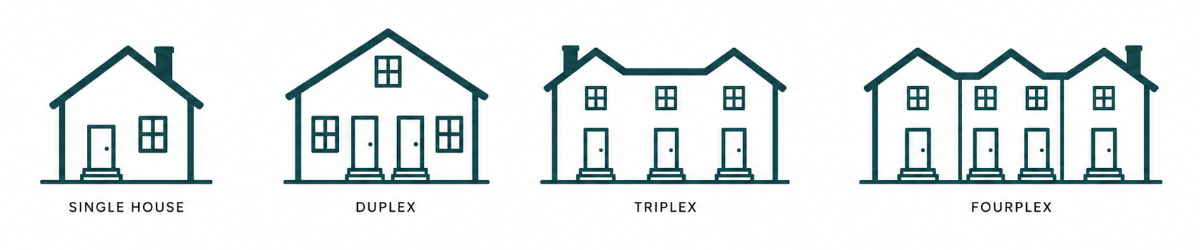
Four line-art icons illustrating different residential property types—a single house, duplex, triplex, and fourplex—labeled below each graphic.
A 2-4 unit property generally falls into one of three configurations:
- Duplex: two separate units, often side-by-side or stacked, on a single parcel with a single deed
- Triplex: three separate units within one structure
- Fourplex (or quadplex): four separate units within one structure
Each unit typically has its own kitchen, bathroom, and separate utility connections, and the property is bought and sold as a single asset rather than as individually owned units. Some lenders also treat a primary structure paired with a legally recognized accessory dwelling unit (ADU) as a two-unit property, depending on local zoning and occupancy rules.
Kiavi Tip: Confirming how the local jurisdiction counts units, and whether the certificate of occupancy matches the number of kitchens and separate entrances on the property, could help real estate investors avoid a financing surprise late in the deal.
How a Bridge Loan Can Fund a 2-4 Unit Acquisition and Rehab
A bridge loan could finance the purchase and renovation of a 2-4 unit property in a single short-term loan that typically covers acquisition and rehab costs together. That structure may suit a real estate investor buying a duplex, triplex, or fourplex that needs work before any unit is rent-ready, since a DSCR loan generally depends on rental income that doesn't exist yet.
Bridge loans for multi-unit properties tend to share a few features:
- Interest-only payments during a short loan term
- Draws released as renovation milestones are completed, often across each unit's individual scope of work
- Loan sizing tied to the after-repair value (ARV) of the property as a whole, not unit by unit
Renovating a 2-4 unit property can add coordination work that a single-family rehab doesn't require, since contractors may be scoping and repairing multiple kitchens, bathrooms, and mechanical systems under one roof and one draw schedule. Technology-enabled lenders, like Kiavi, often manage that draw process digitally, which could give real estate investors real-time visibility into inspection status across a multi-unit rehab instead of waiting on manual updates.
Kiavi Tip: Real estate investors weighing a bridge loan for a 2-4 unit deal can use an ARV estimate to model the after-repair value across all units before committing to a purchase price. For a broader look at how bridge financing works, the guide to hard money and how it works is a useful starting point.
How a DSCR Loan Qualifies a 2-4 Unit Rental Property
A DSCR loan for a 2-4 unit rental property is typically qualified using the combined gross rental income from all units, divided by the property's monthly debt obligations, rather than the borrower's personal income or tax returns. DSCR loans commonly cover single-family rentals alongside 2-4 unit properties, condos, and planned unit developments.
The formula itself is simple: gross monthly rental income divided by PITIA (principal, interest, taxes, insurance, and any HOA dues). A DSCR of 1.0 means the combined rent exactly covers the debt payment; a ratio of 1.25 or higher is generally considered healthy by most lenders.
Example: Triplex acquisition
|
Line Item |
Amount |
|
Purchase price |
$450,000 |
|
Down payment |
$112,500 |
|
Loan amount |
$337,500 |
|
Combined monthly rent (3 units) |
$4,800 |
|
Estimated monthly PITIA |
$3,150 |
|
DSCR (4,800 / 3,150) |
1.52 |
Actual terms vary by lender, market, and deal specifics.
On a multi-unit property, the income side of that calculation usually comes from adding together the appraiser-estimated market rent for each unit, not necessarily what's stated on any existing lease. That distinction could work in a real estate investor's favor when a unit is currently rented below market, since the appraisal-based figure may be higher than the actual lease amount.
Kiavi Tip: Gathering current leases, unit-level rent history, and a rent roll before applying could speed up underwriting on a multi-unit DSCR loan, since the lender typically needs income documentation for every unit, not just the property as a whole.
Bridge Loan vs. DSCR Loan: Which Fits a 2-4 Unit Deal?
Choosing between a bridge loan and a DSCR loan for a 2-4 unit property generally comes down to whether the units are already generating qualifying rental income or still need renovation before they can be rented. The table below compares the two options side by side.
|
Option |
Best For |
Key Consideration |
|
A 2-4 unit property that needs renovation or isn't yet rent-ready |
Short-term and interest-only, sized to the after-repair value across all units |
|
|
A 2-4 unit property that's already generating rental income at or near market rent |
Qualification depends on combined unit rent relative to the loan's monthly debt obligations |
A simple decision framework could help narrow the choice further:
- If the property needs renovation or doesn't yet have rent-ready units: a bridge loan is typically the more direct starting point.
- If all units are already occupied and rented at or near market rent: a DSCR loan could be the more efficient path.
- If the combined DSCR comes in below 1.0 even with stabilized rent: some real estate investors bring additional cash to closing, adjust the offer price, or start with a bridge loan and refinance once rents catch up to market.
Kiavi Tip: For a side-by-side look at how bridge and DSCR products fit different investor situations more broadly, which Kiavi loan fits your situation walks through the same underlying logic from a slightly different angle.
What Changes in Underwriting When a Property Has Multiple Units?
Underwriting a 2-4 unit property typically requires more documentation than a single-family purchase, since a lender usually needs to verify income, condition, and insurance coverage for each unit rather than just one.
"Deals on 2-4 unit properties more often stall over incomplete unit-level documentation, such as a missing rent roll or unclear lease terms, than over the borrower's credit profile."
A few areas typically get extra attention on a multi-unit deal:
- Separate lease terms and rent history for each unit, where applicable
- Property insurance that reflects a multi-unit structure rather than a single-family policy
- Local zoning and occupancy compliance for the recognized number of units
- Whether any unit is owner-occupied, which could shift the loan into a different program entirely
New construction typically hasn't kept pace with demand in this segment. Multifamily missing middle construction, which the National Association of Home Builders defines as apartments in 2- to 4-unit properties, totaled just 16,000 starts over the four quarters ending in the second quarter of 2026, down from 21,000 in the prior four-quarter period. That kind of pullback in new small multifamily supply could keep more of the demand for 2-4 unit properties concentrated on existing buildings, which is where underwriting quality on the deal itself becomes especially important.
Kiavi Tip: Pulling a certificate of occupancy and confirming it matches the actual unit count before underwriting begins could prevent a late-stage surprise if a unit was added without permits.
Can you refinance a Bridge loan into a DSCR loan?
Yes, a bridge loan can typically be refinanced into a DSCR loan on a 2-4 unit property once the units are rented and stabilized at or near market rent. This bridge-to-DSCR sequence mirrors the BRRRR approach that many real estate investors already use on single-family properties, just applied across multiple units at once.
The sequencing typically looks like this:
- Acquire the 2-4 unit property with a bridge loan sized to the ARV across all units
- Complete renovations unit by unit, often on a staggered timeline to keep at least some units generating income sooner
- Lease each unit at or near market rent
- Refinance into a DSCR loan once the combined rent roll supports a qualifying DSCR
Household formation and rental demand could remain part of the backdrop for this strategy. Individual investors accounted for 18% of home purchases in early 2026, up from 15% a year earlier, according to the National Association of Realtors, while single-family rent growth held at 1.3% year-over-year in May 2026, per Cotality (formerly CoreLogic). Multifamily construction starts also rose 17% in 2025, according to the Harvard Joint Center for Housing Studies, though total activity remained well below the 2022 peak, which could keep some rental markets tighter than they'd otherwise be.
Kiavi Tip: For a deeper look at how the refinance step works mechanically, DSCR loan for BRRRR: how the refinance step works covers what lenders evaluate and how to model the numbers, and the refinancing roadmap for real estate investors is a useful reference for the broader process.
Final Thoughts
Financing a 2-4 unit property usually comes down to timing: a bridge loan for the acquisition and rehab phase, a DSCR loan once the units are rented and stabilized, or a bridge-to-DSCR sequence that uses both. With new construction of small multifamily buildings still limited, the existing 2-4 unit stock could remain a meaningful opportunity for real estate investors willing to underwrite it carefully, unit by unit.
Real estate investors ready to compare options for a specific 2-4 unit deal can check current bridge and DSCR terms.
Sources
- Multifamily Missing Middle Falls Back, NAHB Eye on Housing, August 2026
- Monthly New Residential Construction, July 2026, U.S. Census Bureau and HUD, August 2026
- Research Update, National Association of Realtors, June 2026
- The State of the Nation's Housing 2026, Harvard Joint Center for Housing Studies, June 2026
- Annual Single-Family Rent Growth Remains Below Trend, Cotality (formerly CoreLogic), July 2026
- National Multifamily Market Report, Yardi Matrix, June 2026
%20(1).png)
Explore Related Content

10 Key Real Estate Investor Metrics to Track for Success
Editor's Note - Updated May 2026: This post has been updated to include a reference to Arizona..

Mid-Year Fix-and-Flip Market Check: Where Investors Are Winning in 2026
Not every fix-and-flip market is moving the same direction in 2026. Some states entered the..

The Best Real Estate Investment Strategy for 2026: 3 Approaches Compared
Editor's Note - Updated July 2026: This post has been updated to include a reference toAmerica's..
You are leaving kiavi.com. Do you want to continue?